
The Moroccan women’s djellaba is the garment you will see more than any other in this country, and the one most visitors misunderstand. It is not a costume, not a relic, and not something reserved for special occasions. It is ordinary clothing, worn today by women going to work, to the market, to a wedding and to visit family, in fabrics and cuts that have kept changing for centuries while the shape has stayed recognisably itself.
This guide covers what a djellaba actually is, how it differs from the kaftan and the takchita it is so often confused with, the craft that goes into a good one, and how to buy one properly if you want to take one home.
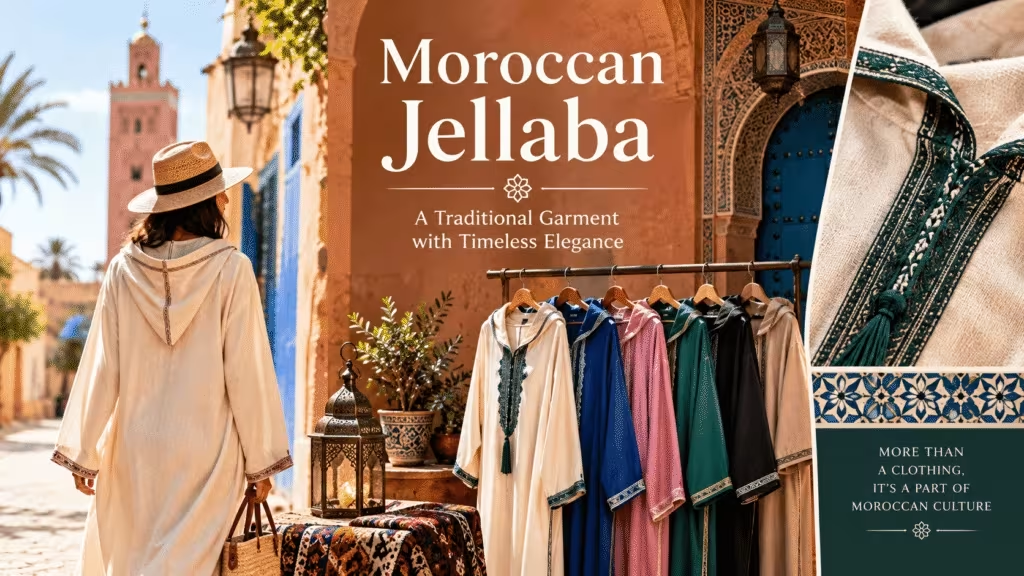
What is a djellaba?
A djellaba is a long, loose outer robe with full sleeves and, crucially, a pointed hood called the qob. It reaches the ankles, it is cut to hang away from the body rather than follow it, and it is worn over other clothes rather than instead of them. That last point is what defines it: the djellaba is outerwear.
The hood is the giveaway. If a garment has no hood, it is not a djellaba, whatever a market stall tells you. The qob was originally practical, shade from the sun in the south and shelter from wind and rain in the mountains and along the Atlantic, and it survives as the single feature that identifies the garment at a glance.
Djellaba, kaftan, takchita, gandoura: the differences
These four words get used interchangeably in tourist markets and they mean quite different things.
| Garment | What it is | Worn |
|---|---|---|
| Djellaba | Hooded, loose, full-sleeved outer robe | Daily, outdoors, over other clothes |
| Kaftan | No hood, one layer, often fitted at the waist with a belt | Indoors and for celebrations |
| Takchita | Two layers: an under-dress and an open over-dress, fastened with a wide belt | Weddings and formal occasions |
| Gandoura | Short-sleeved or sleeveless, no hood, lighter | Summer, at home, more casual |
The practical rule: hood means djellaba, belt and two layers means takchita, and a single elegant robe with no hood is a kaftan.
A short history
The djellaba’s roots are Amazigh and North African, and the garment predates the arrival of many of the influences now woven into it. For most of its history it was worn chiefly by men, in undyed wool, grey or brown, made from the fleece of the family’s own sheep in mountain villages.
The women’s djellaba as an everyday garment is largely a twentieth-century development, and it spread quickly. Through the 1950s and 60s it became the standard outer garment for women across Moroccan cities, and from the 1980s onward it moved decisively into fashion: lighter fabrics, brighter colours, tailored shoulders, embroidery that became a designer’s signature rather than a village’s.
What is striking is that modernisation did not replace the garment. Moroccan women did not stop wearing djellabas as they entered universities and offices. They redesigned them.
The craft: fabric, trim and hood
Fabric
Traditional winter djellabas are wool, and a good one is heavy, warm and lasts decades. Summer versions use cotton, linen or light synthetics. The luxurious end uses sabra, often sold as “cactus silk”, along with brocade and jacquard for formal wear.
Sfifa and aqad
This is where the craftsmanship lives. Sfifa is the decorative braid trim that runs down the front opening and around the neckline, hand-made from silk thread twisted into fine cord. Aqad are the hand-knotted button loops that fasten it, made from the same cord and formed one at a time.
A machine-made djellaba has glued or stitched-on trim and plastic buttons. A hand-finished one has sfifa applied by hand and real aqad closures, and the difference is visible from a metre away once you know to look. The people who make sfifa are specialists; the work is slow and it is the single clearest marker of quality.
The hood
A well-made qob is structured enough to sit properly when down, and deep enough to actually cover the head when up. On cheap garments it is a floppy triangle that does neither.
Regional styles
- Fes is the reference point for fine embroidery and formal work. Fassi tailoring, silk thread and elaborate sfifa are the benchmark against which others are measured.
- Marrakech leans brighter and bolder, with strong colour and more contemporary cuts aimed partly at a fashion market.
- Rabat and Salé are known for restrained, elegant urban styles and a particular embroidery tradition.
- The Rif and the Atlas keep heavier wool and simpler, more practical construction, in undyed or naturally dyed cloth.
- The south favours lighter fabric and looser cut, built for heat.
When it is worn
Everyday djellabas are plain or lightly trimmed and entirely ordinary: worn to the market, to work, to drop children at school. Formal ones, in heavier fabric with dense sfifa, appear at weddings, religious holidays, family celebrations and funerals.
Ramadan and Eid see the finest examples worn in public, and a wedding is where you will see the whole spectrum, often with the bride changing several times across the evening.
Buying a djellaba: what to look for
If you want to bring one home, a few checks separate a good purchase from a souvenir that stays in a drawer:
- Look at the sfifa. Hand-made braid is slightly irregular, tightly twisted and stitched down. Machine trim is uniform and often glued.
- Check the aqad. Real knotted loops, not plastic buttons or a zip.
- Test the hood. Put it up. It should sit properly, not collapse.
- Feel the weight. Wool for winter, cotton or linen for summer. If it feels like cheap polyester, it is.
- Check the seams inside. Finished seams indicate a tailor; raw overlocked edges indicate volume production.
- Buy where Moroccans buy. The tourist lanes of any medina charge several times what a neighbourhood tailor’s shop does for better work.
- Consider having one made. In Fes or Rabat a tailor will make one to measure in a few days, often for less than a mediocre ready-made one costs in the souk, and it will fit.
Expect to bargain in the souks; it is normal and expected, and starting around half the asking price is not rude. In fixed-price cooperatives and boutiques, do not.
Can visitors wear one?
Yes, and it is taken as a compliment rather than appropriation. Moroccans are generally delighted to see a visitor wearing a djellaba, particularly if it was bought locally and worn with some care rather than as fancy dress. It is also genuinely practical: modest, cool in the sun, warm at night in the desert, and it solves the question of what to wear in more conservative towns.
The one thing to avoid is treating it as a costume for photographs while behaving in ways that would be out of place in the setting. Wear it as clothing, and it reads as respect.
Caring for it
Wool djellabas should be dry-cleaned or hand-washed cold and dried flat, never wrung. Cotton and linen wash normally but should be line-dried out of direct sun to protect the colour. Store on a wide hanger so the shoulders hold their shape, and keep hand-made sfifa away from rough zips and velcro, which snag the silk cord.
Seeing the craft for yourself
The tailoring and textile workshops of Fes are the best place to see this made properly, along with the dyers’ souk and the silk-thread workshops that supply the sfifa makers. Marrakech’s souks show the contemporary end of the trade, and Rabat and Salé the restrained urban tradition.
On a private tour we can build in time with an actual tailor rather than a shop set up for tour groups. Our 3-day Marrakech to Fes tour ends in the right city for this, and a longer trip such as the 15-day Morocco tour takes in Fes, Rabat and Marrakech, which between them cover the whole tradition. Read more about craftsmanship in Morocco, browse our tours, or ask us to include a workshop visit.
Frequently asked questions
What is a Moroccan women’s djellaba?
A djellaba is a long, loose outer robe with full sleeves and a pointed hood called the qob, worn over other clothes. It is everyday outerwear for Moroccan women rather than a ceremonial costume, made in wool for winter and cotton or linen for summer.
What is the difference between a djellaba and a kaftan?
The hood. A djellaba has one and is worn as an outer layer over other clothing; a kaftan has no hood, is a single layer, often belted, and is worn indoors or for celebrations. A takchita is a two-layer formal version with a wide belt.
How much does a good djellaba cost?
Prices vary enormously with fabric and finish. A simple cotton everyday djellaba is inexpensive, while a hand-finished wool or sabra one with hand-made sfifa braid and knotted aqad closures costs many times more. Having one tailored to measure often costs less than a mediocre ready-made one in a tourist souk.
Can tourists wear a Moroccan djellaba?
Yes. It is generally received as a compliment, especially if bought locally and worn as ordinary clothing rather than as a costume. It is also practical: modest, cool by day and warm on desert nights.
How do I know if a djellaba is handmade?
Check the sfifa braid trim and the aqad button loops. Hand-made braid is slightly irregular and stitched down; machine trim is perfectly uniform and often glued. Real aqad are knotted silk loops rather than plastic buttons or a zip. Finished interior seams also indicate a tailor rather than mass production.
Where is the best place to buy a djellaba in Morocco?
Fes for fine traditional tailoring and embroidery, Rabat and Salé for restrained urban styles, and Marrakech for contemporary cuts. Wherever you buy, prices in neighbourhood tailors’ shops are far better than in the main tourist lanes, and having one made to measure takes only a few days.