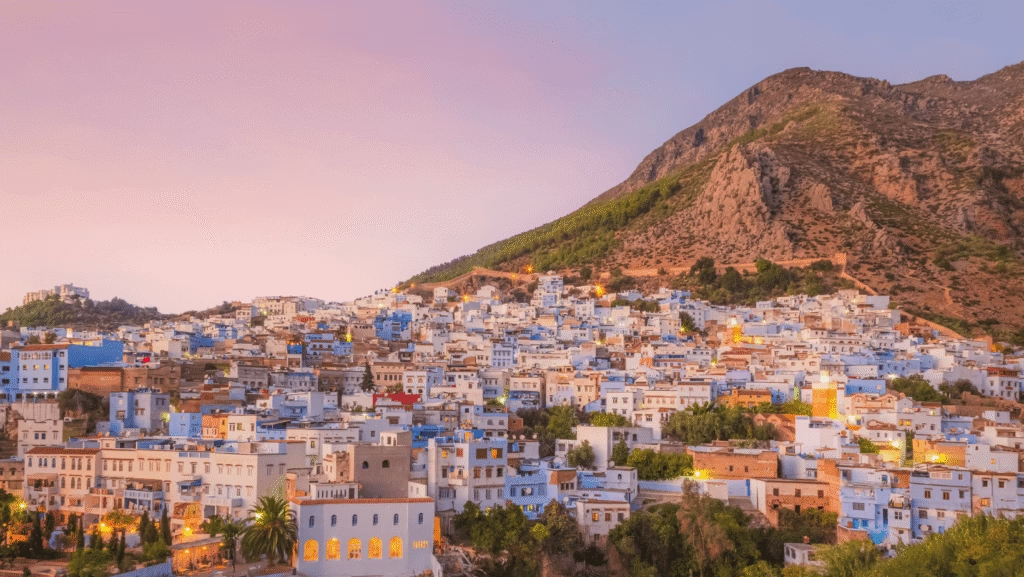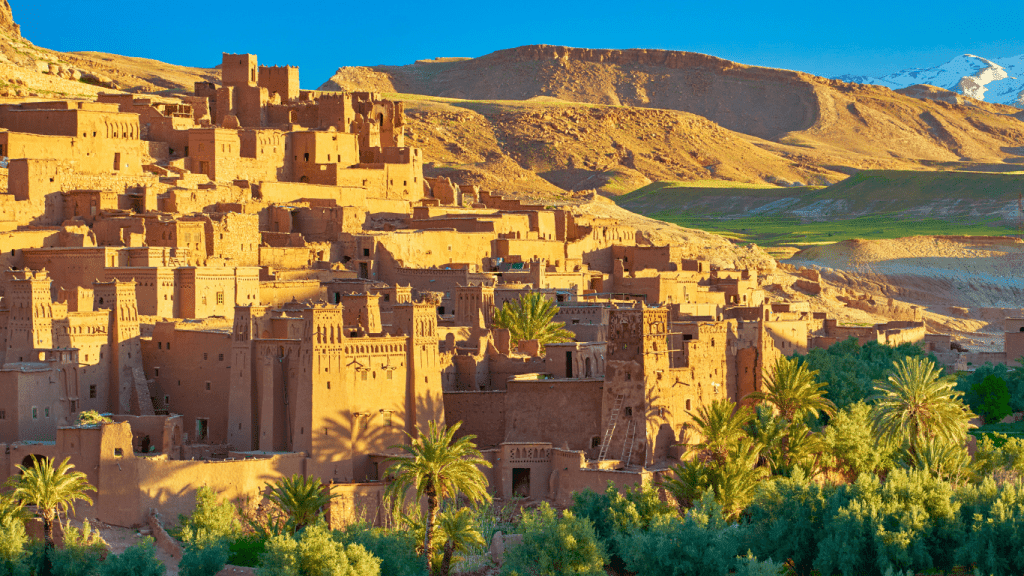
Argan oil is the most Moroccan thing you can put in a suitcase. It comes from a tree that grows wild almost nowhere else on earth, it is still cracked open by hand because no machine has ever managed it properly, and it is sold on every third corner of every medina in the country — a good deal of it fake.
This guide covers what argan oil actually is, how it is made, the difference between the culinary and cosmetic versions, what it genuinely does, and how to tell real oil from the coloured sunflower oil sold to tourists. We are a Moroccan tour operator and we take people to the co-operatives regularly, so most of this comes from watching the process rather than reading about it.
What argan oil is
Argan oil is pressed from the kernels inside the fruit of Argania spinosa, a thorny, slow-growing tree that survives on very little water and can live for two hundred years. It grows wild in one region of the world: a belt of south-west Morocco roughly bounded by Essaouira in the north, Agadir on the coast and Taroudant inland, with the Souss valley at its centre.
UNESCO designated that area a Biosphere Reserve in 1998, largely because the argan forest holds back the desert. The trees stabilise the soil, their roots reach deep enough to survive drought, and the woodland beneath them supports grazing that would otherwise be impossible. The oil matters economically, but the tree matters ecologically, and the two are tied together.
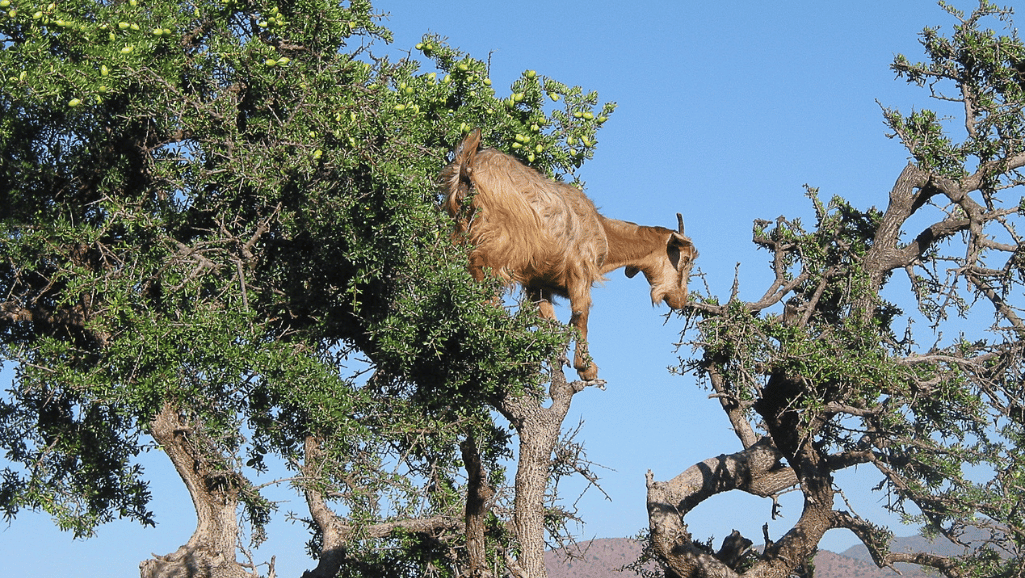
Yes, the goats really do climb the trees
They do. Argan trees are low, wide-branched and climbable, the fruit is edible, and goats in the Souss will go two or three metres up to reach it. It is one of the strangest sights in Morocco.
Two honest caveats. First, along the tourist road between Marrakech and Essaouira you will pass trees with goats arranged in them and someone waiting to collect a fee for photographs. Some of those animals are placed there and kept there all day. If that bothers you, and it reasonably might, keep driving — goats climb these trees unprompted all over the region.
Second, the story about the finest oil coming from kernels retrieved from goat droppings. This was once real practice: goats eat the fruit, the hard nut passes through, and the nuts were collected afterwards. It is not how commercial oil is made today, and any co-operative will tell you so plainly. Modern production strips the pulp mechanically before the nut is ever cracked.
How argan oil is made
The process has barely changed, and the reason the oil stays expensive is that the hardest step still cannot be mechanised.
1. Harvest and drying
The fruit falls from June onwards and is gathered from the ground rather than picked. It is dried in the open, then the fleshy pulp is stripped away to leave a nut with a shell harder than a hazelnut’s.
2. Cracking
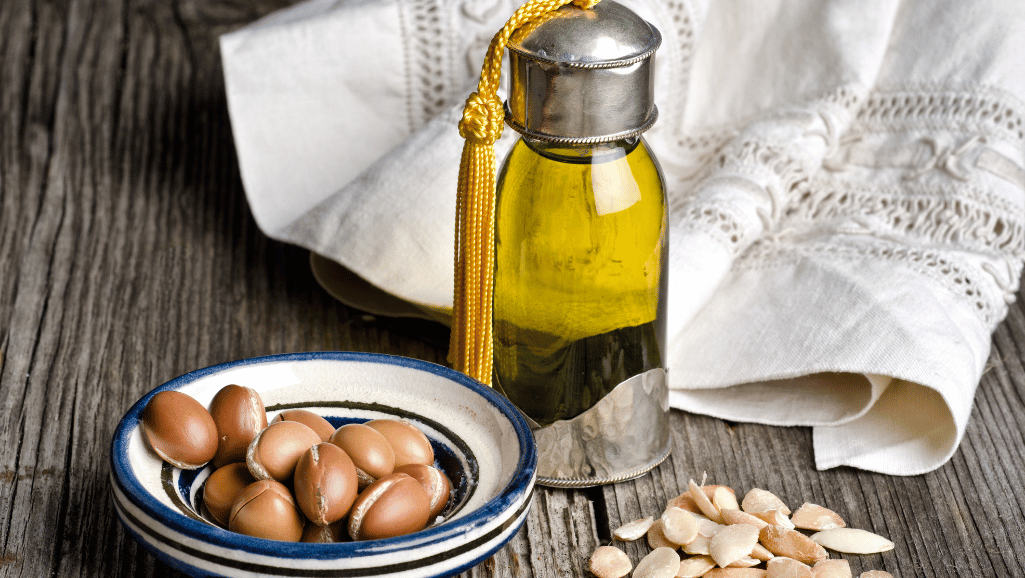
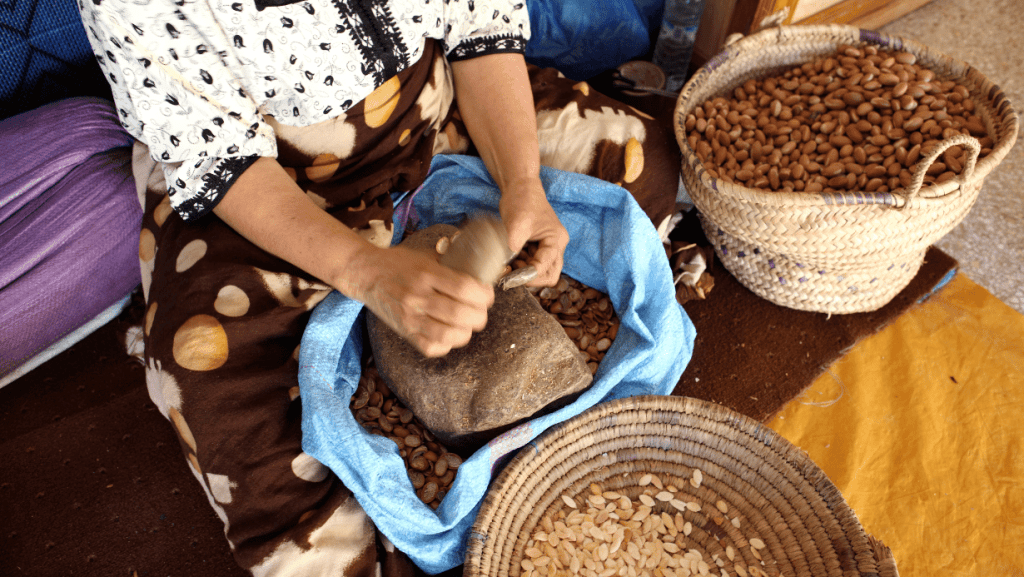
Each nut is cracked between two stones, one held in the hand as a hammer, the other resting in the lap as an anvil. Inside are one to three small kernels. This is the bottleneck of the entire industry: machines crush the kernel along with the shell, so it is done by hand, nut by nut, almost always by women. A skilled worker gets through a few kilos of nuts in a day and produces a strikingly small amount of kernel.
3. Roasting — culinary oil only
If the oil is for eating, the kernels are gently roasted first. This is what gives culinary argan its deep amber colour and its toasted, nutty smell. Cosmetic oil skips this step entirely, which is why it is paler and almost odourless.
4. Grinding
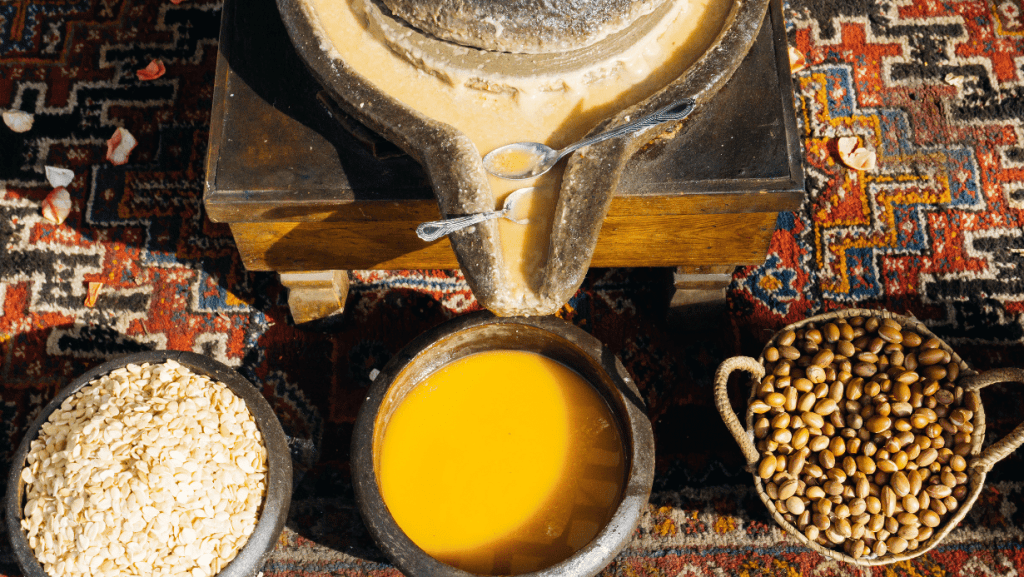
The kernels go into a stone hand-mill — a rotating quern turned by hand — and come out as a thick brown paste.

5. Kneading or pressing
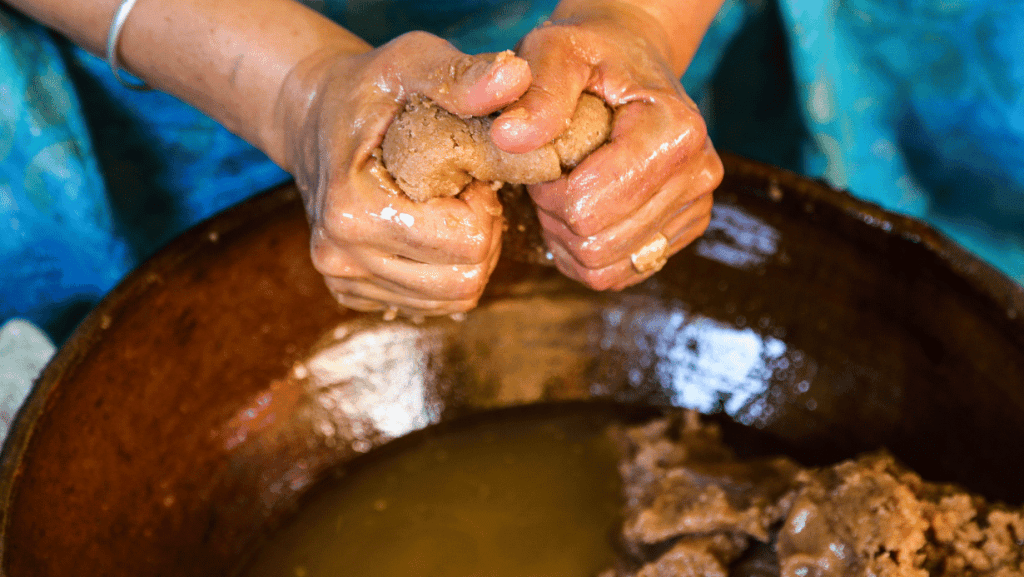
Traditionally the paste is kneaded with a little warm water until the oil separates and can be poured off. Most co-operatives now use a mechanical cold press instead, which is cleaner, adds no water and gives oil that keeps far longer. Purists prefer the hand-kneaded version for cooking; for cosmetic oil, cold-pressed is better.
6. Settling
Fresh oil is cloudy. It is left to stand for a week or two so the sediment drops out, then decanted. Cosmetic oil is usually filtered further.
Culinary or cosmetic: they are not the same bottle
This confuses almost everyone, so it is worth being blunt about it.
- Culinary argan oil is made from roasted kernels. Deep gold, strongly nutty, tasting somewhere between hazelnut and sesame. You drizzle it on salads, on bread, over a tagine or into soup at the table. You do not fry with it — heat destroys both the flavour and the point.
- Cosmetic argan oil is made from unroasted kernels, cold-pressed and filtered. Pale yellow, very little smell. This is the one that goes on skin and hair.
If a shop offers you a single bottle and says it does both jobs, they are selling you a blend, or they are selling you something that is not argan oil.
Amlou
The best argument for culinary argan is amlou: roasted almonds ground with argan oil and honey into a thick, sweet spread eaten with bread at breakfast. It is often called Moroccan Nutella, which undersells it considerably. If you try one argan product in the country, try this one. Our guide to traditional Moroccan food covers where it sits in a Moroccan breakfast.
What it actually does
Argan oil is high in oleic and linoleic acid and contains notably more vitamin E than olive oil. In practical terms it is an excellent moisturiser and a good conditioning oil for hair, it absorbs without leaving much of a film, and it is mild enough for most skin.
Be sceptical of anything beyond that. It is a good oil, not a medicine, and the more extravagant claims made in medinas and in marketing copy are not supported by strong evidence. Buy it because it works well and because it is made a few hours from where you are standing, not because someone promised it would cure something.
How to tell real argan oil from fake
Adulteration is common, and usually takes the form of argan cut with sunflower or soy oil — or no argan at all. Six checks:
- Price. Real argan takes roughly 30 kilos of fruit and many hours of hand labour per litre. If a 100 ml bottle is priced like a soft drink, it is not argan oil. Bargain hard on carpets; do not bargain argan down to an impossible number and still expect the real thing.
- Smell. Cosmetic argan has a faint, slightly nutty smell that fades within minutes on skin. Culinary argan smells strongly toasted. A bottle that smells of nothing at all, or of perfume, is suspect.
- Colour. Cosmetic oil is pale gold. Culinary is deep amber. Anything bright, uniform yellow has probably been coloured.
- The bottle. Dark glass, sealed, with a batch or production date. A clear plastic bottle decanted in front of you from a large drum tells you nothing about what is in the drum.
- Feel. Real cosmetic argan absorbs quickly. Oil that sits greasy on the back of your hand has been cut with something cheaper.
- Where you buy. A women’s co-operative with the process visible on site is a far safer bet than a shop that appeared on your route because your driver has an arrangement with it.
The co-operatives
Most argan oil is produced by women’s co-operatives, a model that took hold across the region in the 1990s. For many women in rural Souss villages this is the first paid, independent income available to them, and a number of co-operatives run literacy classes and childcare alongside production.
Visiting one is genuinely worthwhile: the cracking, the mill and the press sit within a few metres of each other, and you can buy at the source. Two honest notes. Not every roadside shop with “co-operative” on the sign is one — some are ordinary retailers borrowing the word. And a real co-operative will let you watch the entire process without pressure to buy anything.
Where to see it for yourself
The argan belt sits in the south-west, so it fits naturally onto a few routes:
- The Marrakech–Essaouira road. The most common way to see argan country: the road crosses the forest and passes both goats and co-operatives. A day trip to Essaouira from Marrakech takes this route in both directions.
- Around Agadir and the Souss. The densest argan forest in the country. A day trip to Paradise Valley and Imouzzer runs straight through it.
- Taroudant and inland. Quieter, with working co-operatives that see far fewer coach parties.
If argan is something you specifically want to see made rather than simply buy, say so when you enquire and we will build the stop into the route rather than leaving it to chance. It pairs well with the workshops in our guide to Moroccan craftsmanship.
Frequently asked questions
Is argan oil cheaper in Morocco?
Considerably — often a third or less of what equivalent quality costs in Europe or North America, particularly buying at a co-operative rather than a medina souvenir shop. That price gap is exactly why the fake trade exists.
Can I take argan oil home on a plane?
In checked luggage, without any problem. In hand luggage the usual 100 ml liquid limit applies. Wrap the bottle well: argan oil leaks are memorable for the wrong reasons.
Can I cook with cosmetic argan oil?
You can, but it will taste of very little, because it was never roasted. And you should not put culinary argan on your face — it is unfiltered and smells strongly of toasted nuts. Buy the right one for the job.
How long does argan oil keep?
Cold-pressed cosmetic oil keeps around two years unopened and six months to a year once opened. Traditional hand-kneaded culinary oil contains a trace of water and turns faster — use it within about six months. Keep both away from light and heat.
Is culinary argan oil the same as the cosmetic one?
No. Same tree, same kernel, different processing: roasted for eating, unroasted for skin. The colour and the smell tell you immediately which one you are holding.
Why is real argan oil so expensive?
Because the shell has to be cracked by hand. Every attempt to mechanise it destroys the kernel, so the single most labour-intensive step in the process is also the one nobody can skip. Roughly 30 kilos of fruit and a day or more of work produce about a litre of oil.