The 3-day desert tour from Marrakech to Fez is the most popular route in Morocco, and for good reason: it crosses the High Atlas, runs the length of the southern oasis valleys, puts you on a camel in the dunes of Erg Chebbi for sunset, and delivers you to Fez two days later having crossed most of the country. It is also the trip people most often get wrong, because three days is not much time and the driving is longer than the map suggests.
This is an honest account of what the route involves, what each day actually looks like, and who it suits.
The route in short
| Day | Route | Night |
|---|---|---|
| 1 | Marrakech, Tizi n’Tichka pass, Ait Ben Haddou, Ouarzazate, Dades valley | Dades or Boumalne |
| 2 | Todra gorge, Tinghir, Erfoud, Merzouga, camel trek, desert camp | Sahara camp, Erg Chebbi |
| 3 | Sunrise, Rissani, Ziz valley, Midelt, Azrou cedar forest, Fez | Fez |
Day 1: over the Atlas to the Dades valley
You leave Marrakech early, because the first climb is the big one. The Tizi n’Tichka pass is the highest surfaced road in North Africa, topping out at 2,260 metres, and the road switchbacks through Berber villages built into the slope. It is a slow, spectacular two and a half hours, and worth every stop.
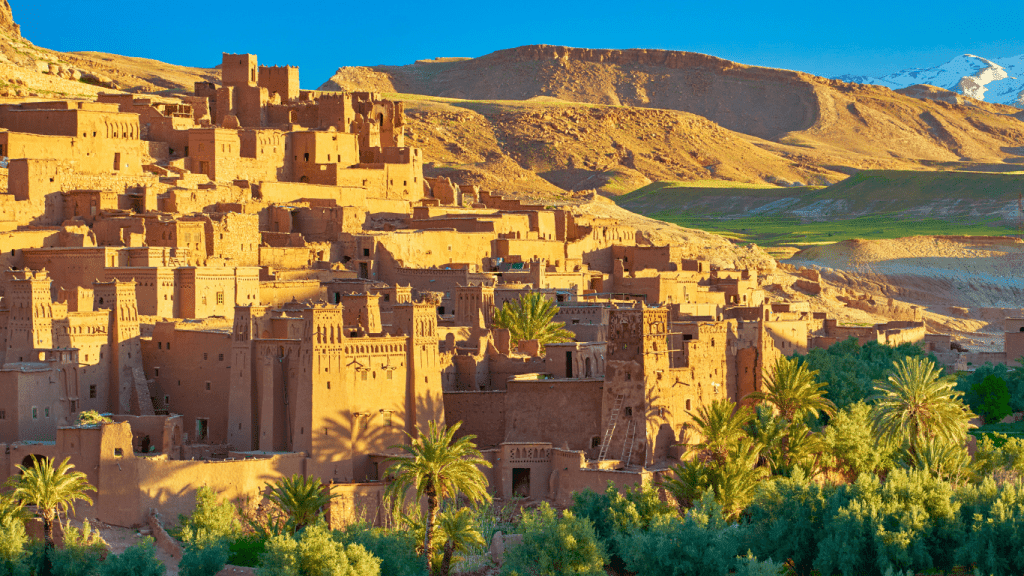
On the far side you drop to Ait Ben Haddou, the fortified ksar whose earthen towers rise in tiers above the Ounila river. It is a UNESCO World Heritage site and one of the most filmed places in the country. Give it an hour on foot; crossing to the far bank and climbing to the granary at the top is the part most people remember.
From there it is Ouarzazate, then east along the Valley of a Thousand Kasbahs to the Dades gorge, where the road folds back on itself between walls of red rock. You sleep in the valley, usually in a small hotel or riad with the gorge behind it.
Day 2: gorges, then the Sahara
The morning belongs to the Todra gorge, a canyon 300 metres deep that narrows until there is barely room for the river and the road together. Walk it early, before the tour buses and the heat.
Then the landscape empties out. Through Tinghir’s long palm groves, past Erfoud and its fossil workshops, and the greenery gives way to hammada, flat black stone, and finally to sand. You reach Merzouga in the afternoon.
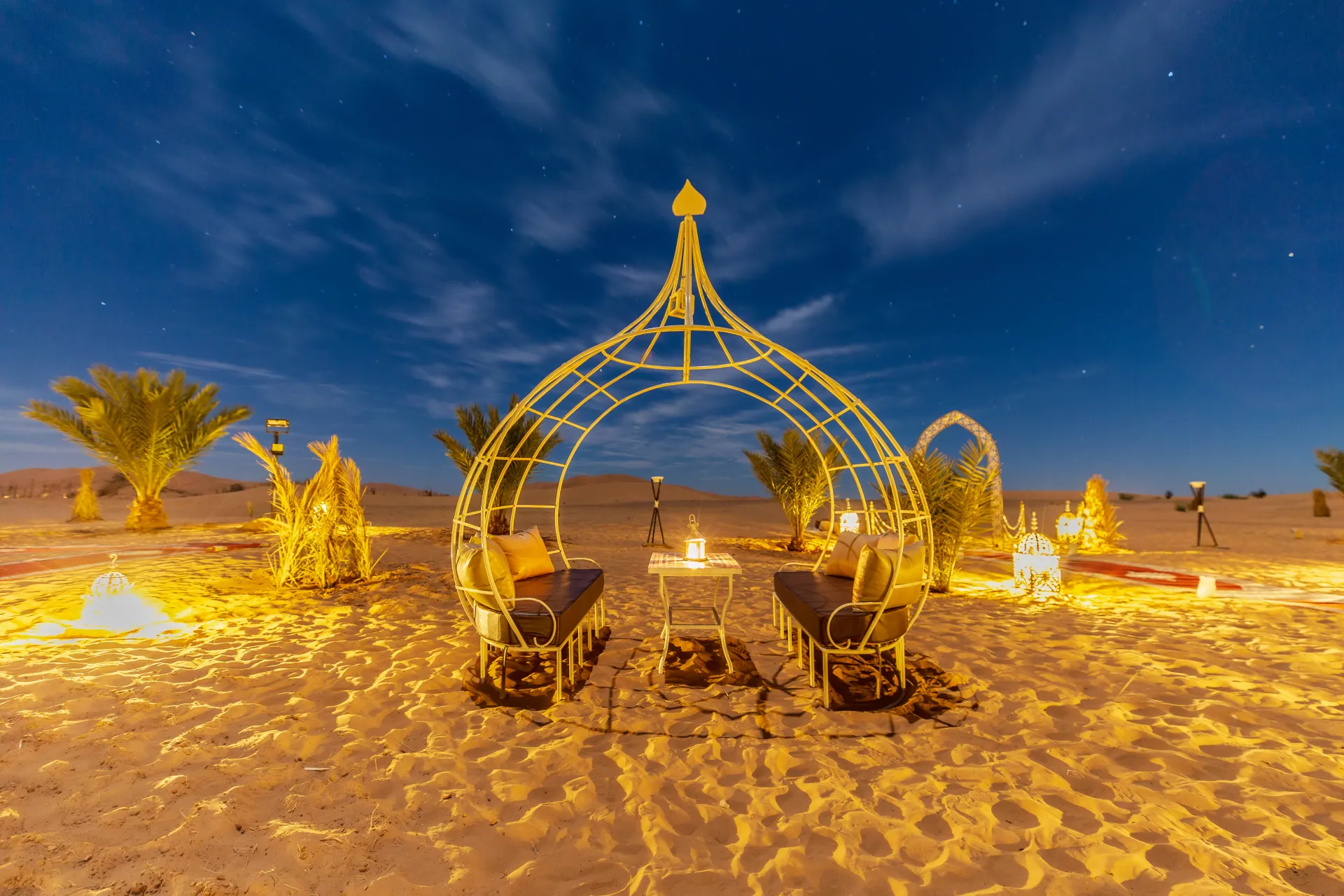
Camels are met at the edge of the dunes and the ride out is timed so the sun goes down while you are among the sand. It takes about an hour and a half. Dinner is at camp, drums come out afterwards, and the sky over Erg Chebbi has no light pollution at all. Whatever else the trip gives you, this is the night people remember.
Day 3: the long road north to Fez
Sunrise over the dunes comes early and nobody regrets it. After breakfast you head north, and this is the longest driving day of the three: roughly seven to eight hours with stops. The Ziz valley is the highlight, a green ribbon of date palms cut through bare rock, followed by Midelt, then the climb into the Middle Atlas.
The cedar forest above Azrou is a genuine surprise on this route, cool and green with Barbary macaques by the roadside, and Ifrane below it looks like an alpine town that took a wrong turn. You reach Fez in the evening.
Is three days enough?
Honestly: it is enough to see the route, not enough to linger on it. Three days gets you the Atlas, the gorges, one night in the desert and the Middle Atlas, which is a lot of country. What it does not give you is slow time. Day three in particular is a long drive.
If you have a fourth day, add it, and the obvious place to put it is a second night in the desert with a full day around Merzouga: nomad families, the old Mascara galleries, the village of Khamlia and its Gnawa musicians. That day turns the desert from a stop into an experience.
If three days is what you have, it still works. Thousands of people do this route every year and very few regret it.
If you have a week rather than three days and want to finish back in Marrakech, the seven-day round trip from Marrakech is this route with the driving spread properly: the same gorges and the same dunes, plus the Draa valley, and time that is not spent in a vehicle.
What is included, and what is not
On a private tour with us the price normally covers a private air-conditioned vehicle, an English-speaking driver-guide, accommodation in riads or small hotels, the desert camp with camel trek, breakfast and dinner each night, fuel and all transport costs, and pick-up and drop-off at your accommodation.
Lunches, drinks, entrance fees, tips and travel insurance are not included. Local guides in the medinas are extra and worth it. We quote per party rather than publishing a fixed price, because the cost per person falls as the group grows.
What to bring
- Layers. The desert is hot by day and genuinely cold at night, and the Atlas passes are cold year-round.
- Closed shoes for the gorges and something you do not mind filling with sand.
- A scarf or shesh for wind and sun. You can buy one on the way.
- Cash. Card acceptance thins out quickly once you leave the cities.
- A small overnight bag for the camp; the main luggage stays in the vehicle.
- Sun protection and more water than you think.
Which direction: Marrakech to Fez, or Fez to Marrakech?
Both run constantly and see the same places. Marrakech to Fez is the more common choice because it puts the hardest driving on the last day, when you are heading towards a city rather than into the desert. Going the other way front-loads the long drive and leaves you finishing in Marrakech, which suits people flying home from there. Choose by your flights, not by the route.
There is a third option people forget: start and finish in Fes. The three-day round trip from Fes reaches the same dunes and returns north, which suits anyone flying in and out of Fes, or carrying on to Chefchaouen afterwards. The two-day version does it faster and is genuinely tight, but it exists for travellers with one spare night rather than two. And if you want this crossing with a day more than we describe here, the four-day Fes to Marrakech run puts that day in the desert instead of on the road.
When to go
Spring, from March to May, and autumn, from September to November, are the best months: warm days, cool nights, comfortable walking. Winter is fine and the desert is lovely by day, but nights at camp are properly cold. July and August are hot enough that the midday hours are spent in the vehicle, and the desert can pass 45°C.
Book the route
You can see the full itinerary, day by day, on our 3-day desert tour from Marrakech to Fes page. If you would rather take the extra day in the Sahara, the 4-day version adds the desert excursion, and the 5-day tour slows the whole thing down. All of them are private, and all can be reshaped. Browse every route on our Morocco tours page or send us your dates.
Frequently asked questions
How long is the drive from Marrakech to Fez via the desert?
Around 1,200 kilometres over three days, which works out at roughly six hours of driving on day one, five on day two and seven to eight on day three, before stops. The distances are the main reason this route is done over three days rather than two.
Is the 3-day desert tour worth it?
Yes, if you accept that it is a crossing rather than a slow holiday. You see the High Atlas, Ait Ben Haddou, two gorges, the Sahara and the Middle Atlas cedar forest. If you want time to sit still, take four or five days instead.
What is the desert camp like?
Tents with real beds and rugs rather than sleeping mats, dinner cooked over a fire, music afterwards, and shared or private bathrooms depending on the camp. The larger camps have private facilities.
Do I need to be fit for the camel trek?
No. The ride is about an hour and a half at walking pace and there is no requirement to ride at all: the camp can be reached by 4×4 if you would rather, and plenty of guests walk part of the way.
Can the tour start or end in a different city?
Yes. Because every tour is private, we can collect you in Casablanca, Tangier or Agadir and finish wherever suits your flights. It changes the driving times, so tell us at the planning stage.
Is three days too rushed with children?
For young children, yes, we would suggest four or five days instead. The day-three drive north is long, and the extra day in the desert gives everyone a break from the vehicle.